Baku: A Bold, Colorful Typeface for Impactful Design
In a world saturated with visual noise, capturing attention is the first and most crucial step. For designers, entrepreneurs, and creators, the tools you choose directly impact your ability to make that initial connection. A typeface isn't just a set of letters; it's a voice, a personality, and a strategic asset. Enter Baku, a premium color font that embodies cool confidence and undeniable presence. This isn't just another thick lettered font; it's a modern typography statement, designed to make your projects stand out in the crowded digital and print landscape.
The Visual Power of Baku: More Than Just Thick Letters
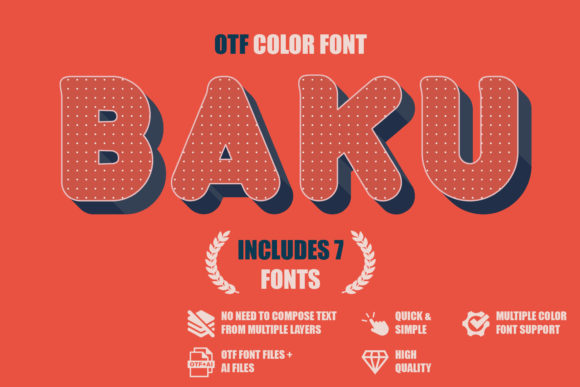
At its core, Baku is a bold, sans serif display font characterized by its strong geometric forms and substantial weight. Its letterforms are clean, modern, and built for impact, ensuring legibility even at smaller sizes while commanding attention at larger ones. What truly sets Baku apart, however, is its nature as a color font (OpenType-SVG). This technology allows each character to contain multiple colors, gradients, and even textures within a single glyph. Imagine a logo where each letter has a subtle gradient, or a social media headline where the text itself is a vibrant, multicolored element. This capability transforms Baku from a simple typeface into a dynamic design asset.
The personality of Baku is one of contemporary edge and creative boldness. It avoids the stiffness of some geometric sans serifs by incorporating slight rounded terminals and a balanced rhythm that feels both professional and approachable. It's a typeface that doesn't whisper; it speaks clearly and with style. Its thick, confident strokes convey stability and strength, making it an excellent choice for projects that need to establish authority or a cutting-edge aesthetic. Whether you're designing a tech startup's brand identity or a musician's album cover, Baku brings a distinct visual voice that is hard to ignore.
Where Baku Shines: Practical Applications for Creators
The versatility of a well-designed display font like Baku makes it a valuable addition to any creative toolkit. Its primary strength lies in applications where a strong visual hierarchy and immediate impact are required. Think of logo design, where a memorable wordmark can define a brand's entire identity. Baku's bold structure and color capabilities allow for logos that are not only recognizable but also inherently unique and modern.
Beyond logos, Baku excels in editorial design for magazine covers, chapter headings, and pull quotes that need to break up the monotony of body text. In packaging design, it can make product names leap off the shelf, creating an instant connection with consumers browsing in a store or online. For digital creators, it's a powerhouse for web design hero sections, impactful call-to-action buttons, and engaging social media graphics. Its ability to maintain clarity at various sizes makes it suitable for both large-scale banners and smaller, yet still bold, promotional text.
For entrepreneurs and small business owners, Baku offers a way to inject personality into marketing materials without sacrificing professionalism. Use it on business cards, presentation title slides, email newsletter headers, or event posters. The font's inherent style helps establish a cohesive brand identity across multiple touchpoints, reinforcing recognition and building a polished image. It's a commercial font designed with real-world projects in mind, offering both creative flair and functional reliability.
Integrating Baku: A Guide for Designers and Marketers
Choosing the right font for a project involves more than just aesthetic preference. It's about evaluating fit, ensuring readability, and considering technical compatibility. When considering Baku, first assess the project's needs. Is it a headline that needs to grab attention in under a second? A logo that must be versatile across print and digital? Baku's bold, condensed nature makes it ideal for these scenarios but may be less suitable for long-form body text where a serif font or a lighter sans serif would offer better readability.
A critical step is testing font pairings. Baku's strong personality pairs best with more neutral, complementary typefaces. Consider pairing it with a clean sans serif font like Montserrat or Open Sans for body text, allowing Baku to handle the headlines. Alternatively, for a more editorial or artistic feel, it could be contrasted with a simple serif font or even a delicate script font for accent text. The key is to create balance, letting Baku be the star of the show without overwhelming the entire design.
It's essential to review the included styles and technical specifications. Remember that Baku is an OpenType-SVG color font. This means its full-color, gradient, or textured effects are accessible in compatible software like Adobe Photoshop, Illustrator, and Inkscape. The standard OTF and TTF files provided are for basic, monochrome use and are not compatible with certain cutting machines like Cricut. Always test the font in your intended design environment to ensure the color features render as expected. For commercial use, verify the licensing to ensure it covers your specific applications, whether for client work, merchandise, or digital products.
Ultimately, integrating a creative font like Baku is about strategic experimentation. Mock up a few concepts to see how it interacts with your other design elements—imagery, color palette, and layout. Observe how it influences the visual hierarchy and the overall tone of your message. Does it make the design feel more energetic, more sophisticated, or more playful? By approaching it as a strategic component of your design assets, you can leverage Baku's unique strengths to create work that is not only visually striking but also effectively communicates your intended brand perception and engages your target audience on a deeper level.